Overview
This document outlines the initial program plan for the gov/acc research program, which was introduced in this Medium post. This program plan focuses on developing an initial research roadmap for decentralized governance in web3 by EthCC 2026.
Goal by EthCC
Activate the relevant community(ies) to produce a visualization (likely a problem leaderboard) of the problems and potential solutions relating to decentralized governance research.
The visualization is not an end in itself - it is supposed to be a mechanism for both a) community building and b) sensemaking.
The roadmap is meant to play a facilitation role - helping those wanting to do certain type of work connect with those doing said work.
Outputs by the first gov/acc workshop at EthCC:
-
An initial visualization (leaderboard) to review and improve together
-
An initial analysis based on the data gathered to produce the roadmap
-
This will likely be the basis of revising the Open Problems in DAOs paper
-
A basic gov/acc website
-
A basic project board for the research program within github to publicly track work and progress
Focus for the Mapping
The purpose of the mapping is to help address the question, ‘What are the pressing problems related to web3 governance?’.
This mapping will be structured around the following:
-
Problem statements (with supporting evidence)
-
Potential solutions (with supporting evidence)
-
Who is working on the potential solutions
Phases to get to this mapping:
-
Phase 1: Data gathering & data structuring
-
Phase 2: Data analysis & synthesis
-
Cleaning up the data
-
Normalizing the data
-
Reviewing the results
-
Revising the data
-
Phase 3: Visualizing the data
-
Reviewing the visualized roadmap
-
Sharing it for initial feedback
-
Initial revision
-
Produce the version of the roadmap to be shared at EthCC
This mapping will likely be done in collaboration with Coordination Network (see the tech tree roadmap example on their site).
The tentative timeline has the data-gathering phase running through late February, with March focused on mapping and revision.
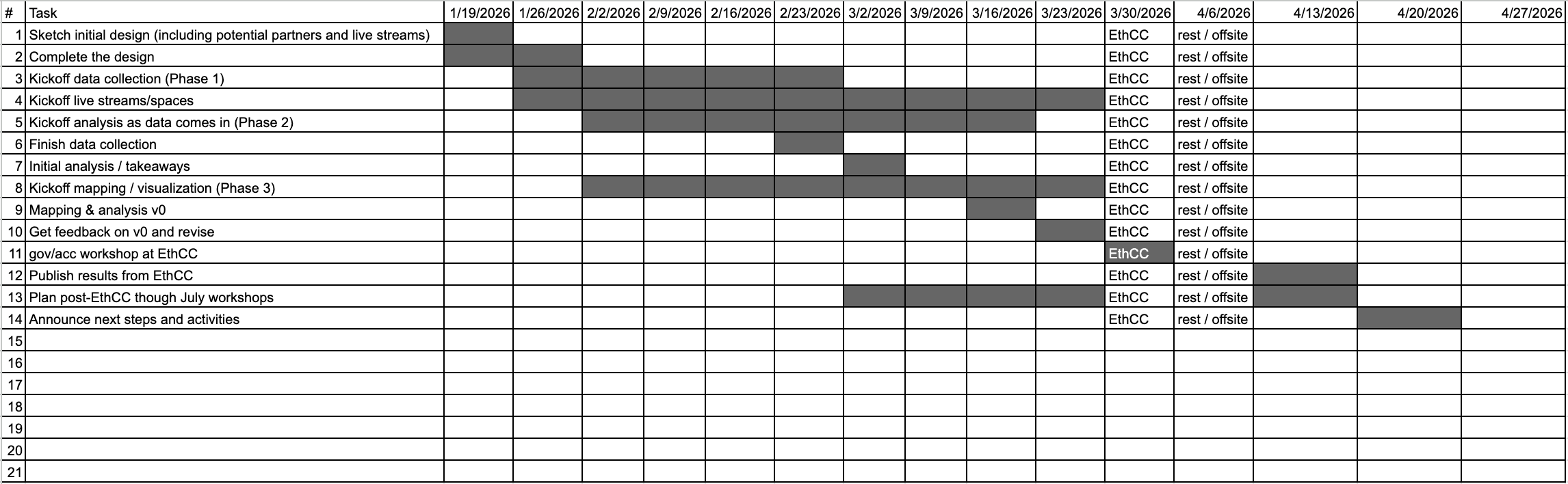
This can be viewed in this Google Sheet: gov/acc Program Timeline
Phase 1: Data Gathering & Initial Structuring
This phase involves having multiple data-gathering options. These options include, but are not limited to:
-
Focused data collection for gov/acc
-
Using a Harmonica-style AI-supported data-gathering tool instead of using traditional surveys
-
Do focused outreach to get more participants using Harmonica, contributing to the unstructured data pool, and to partake in workshops
-
Governance teams
-
Professional delegates
-
Independent delegates
-
Academics
-
Founders, ecosystem, growth, etc.
-
Other governance actors (tooling providers, researchers, etc.)
-
Doing a Miro board workshop with at least one of the focused outreach groups
-
Gathering existing, relevant unstructured data:
-
Transcribing relevant data
-
Building a repo of relevant research, posts, and articles
-
Building a repo of relevant repo’s
Survey / Harmonica Session Design
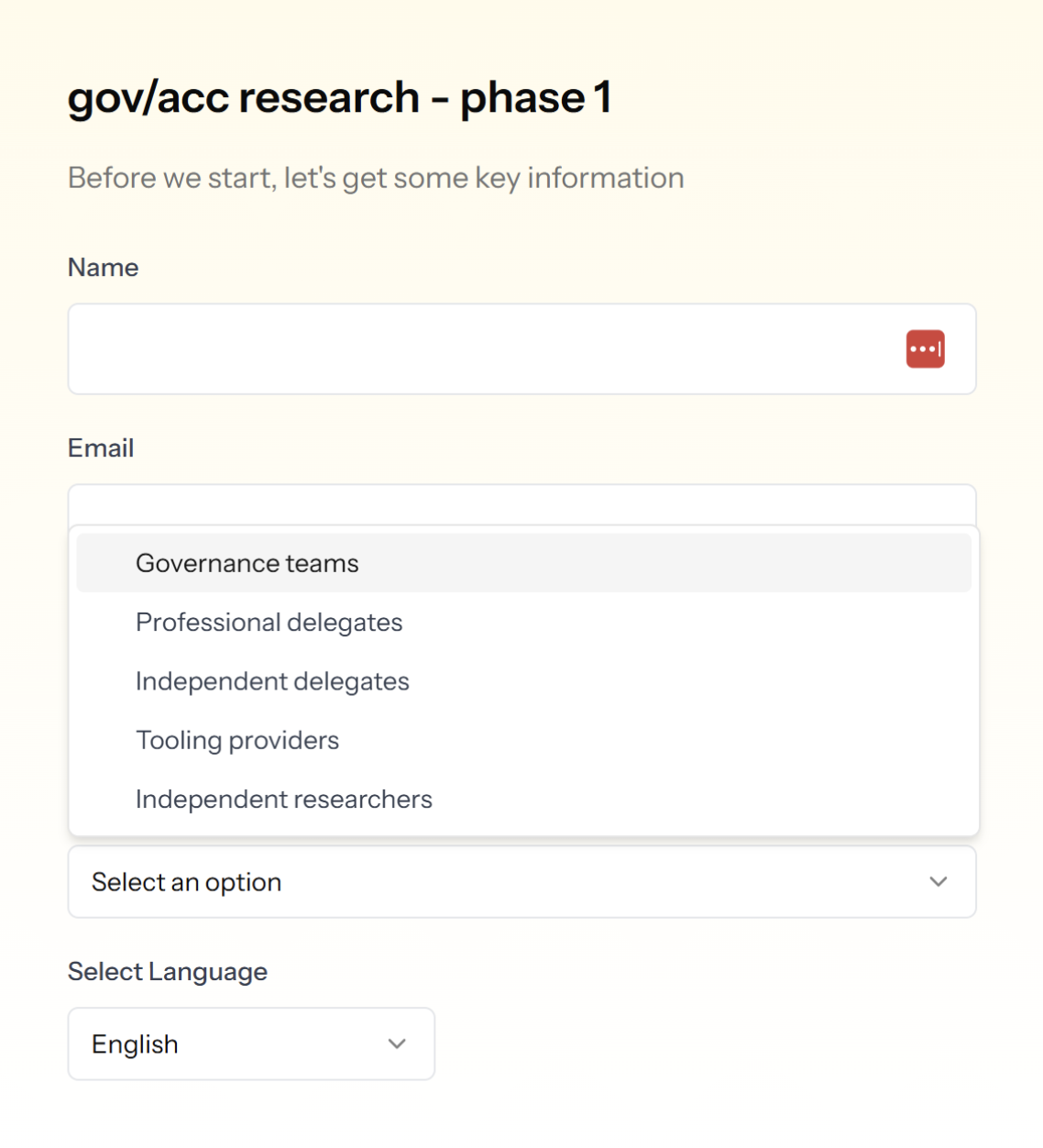
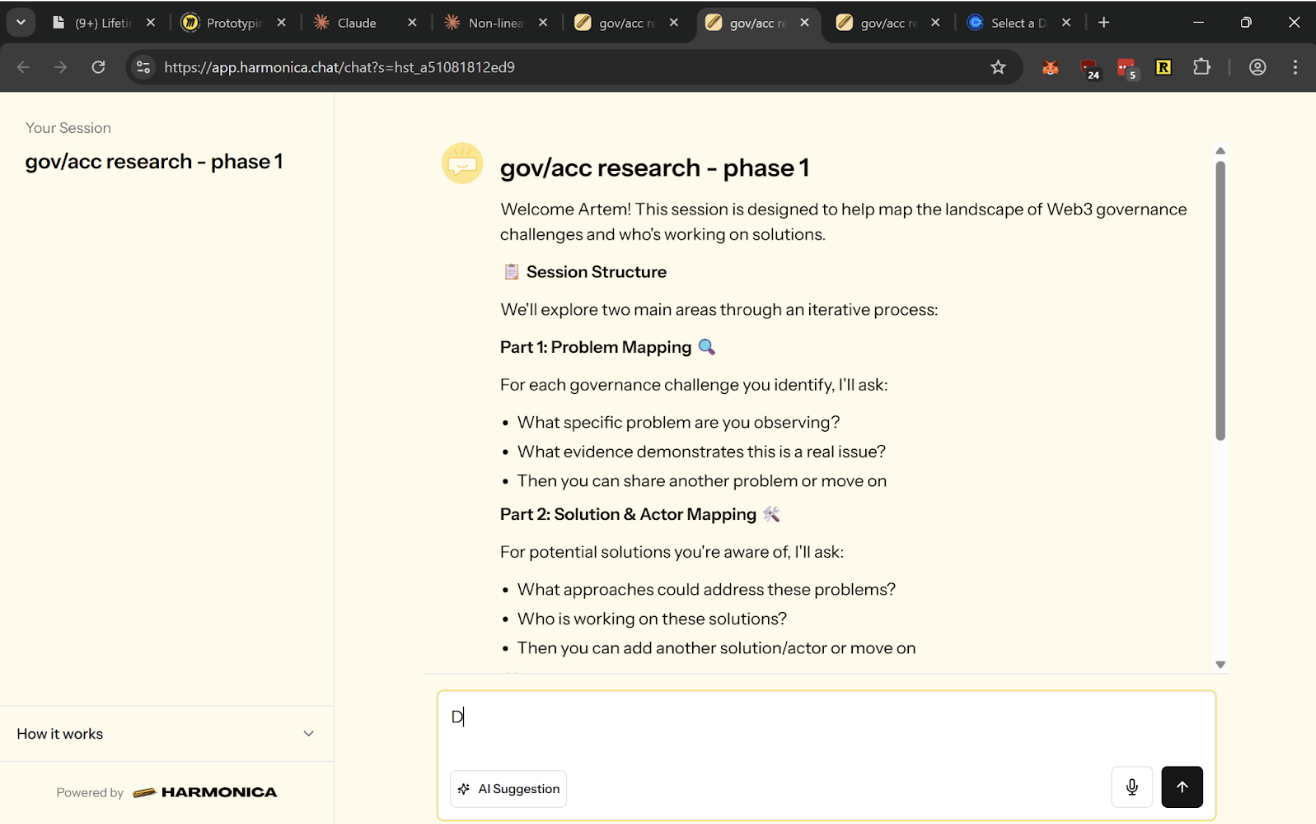
Initial sketch of survey design (multiple submissions allowed). This will be shared with the Harmonica team in order to help inform the design of the Harmonica session.
-
Participant info (before the session)
-
What is your name/what do you prefer to be called
-
Email
-
ENS address
-
Your role
-
Problem mapping: share problem → evidence → continue or move on
-
The more specific the question, the easier it will be to work with
-
Evidence for the above problem statement
-
Solutions/actors: share solutions → who’s working on them → continue or wrap up
-
Who is working on the potential solutions for the above problem?
-
Prioritization (?)
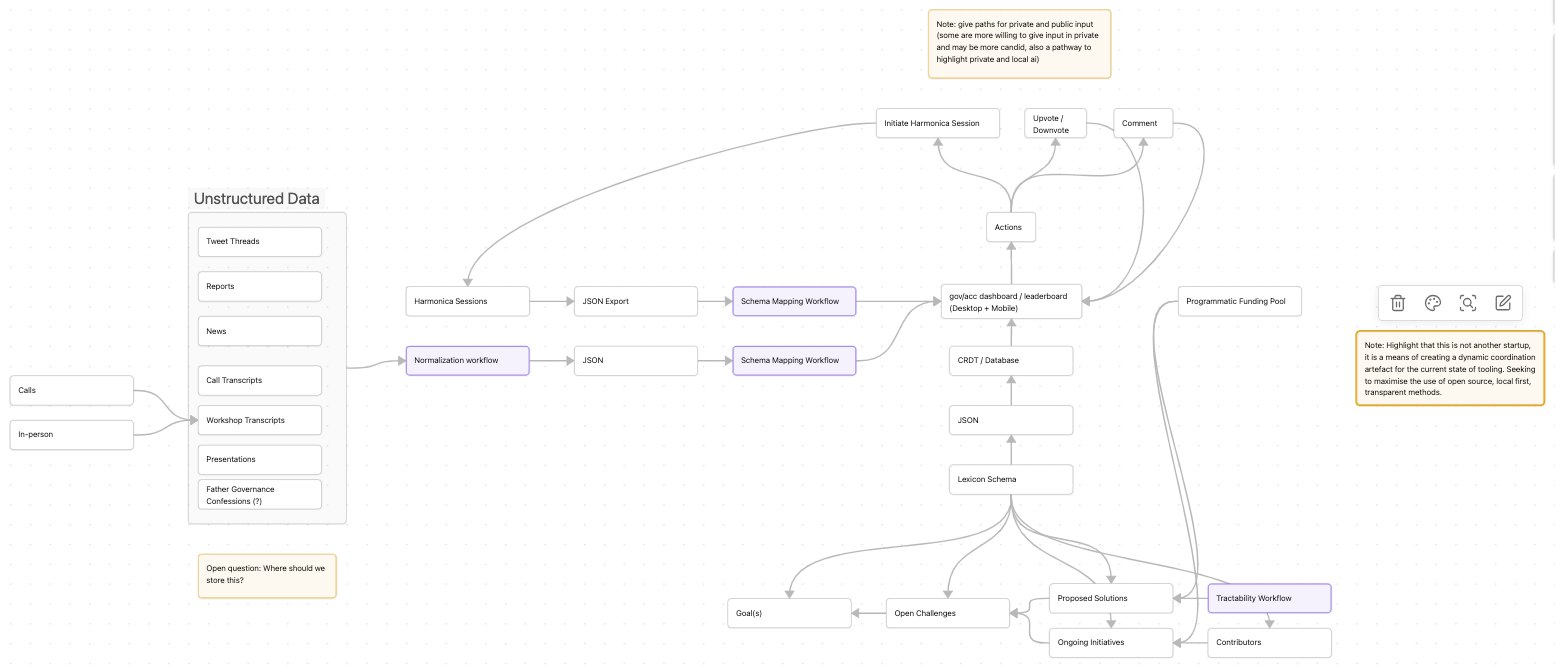
Schematic
Phase 2: Data Analysis & Synthesis
This phase will involve ensuring that all data is reviewed, cleaned, and prepared for easy conversion to the leaderboard.
As such, the first step is to review and clean the data. This section will be filled out in more detail once partnerships with Coordination Network and Harmonica will be finalized, as that will solidify both a) how data is being collected and what data we are gathering, and b) the format the data will need to be in for the mapping.
Additionally, there may be other deliberative tools used in order to provide a more nuanced understanding of the data that we have.
For example, we might use Agora Citizen, Pol.is, or a similar tool different audiences to get a sentiment analysis on the findings from Phase.
Depending on the progress and available time, we may also try to use tools such as Decidim, Ethelo, Evocracy, or others to deliberate some of the findings in more details.
Phase 3: Leaderboard
We will add more details on the leaderboard as we are able to
Ongoing: Communication
See the Content Overview tab.
Milestone 1: gov/acc workshop at EthCC
There will be the first gov/acc workshop at EthCC. The desired outcomes for the workshop will be:
-
Do a review of the roadmap
-
Provide feedback on the analysis
-
Form ‘working groups’ relating to the topics with the most interest
Ways of Getting Involved/Open Challenges
-
This is an excellent example of building the plane as we fly it. We are still figuring out the structure as we go, so it is always helpful to have additional guidance and input on the program design.
-
What is not clear from this and any other documentation?
-
Does new documentation need to be created?
-
Does the project management infrastructure make sense?
-
Is it clear how to get involved, and if no, what can we do to improve it?
-
What flaws exist in the project plan or methodology?
-
Some of the data input and revision will need to be permissioned. What are easy ways for us to gather email and/or wallet addresses for those who want to contribute?
-
What is the identity layer needed for this work?
-
What other deliberative tools are relevant to this process and can be meaningfully used as part of this process
-
Link to relevant resources that outline the relevant tools